Showing posts with label books. Show all posts

Wednesday, December 30, 2009

He Fixes The Cable?

There's an article in today's New York Times about a new book of essays inspired by The Big Lebowski. You should read it. It's pretty interesting, as articles about books go.

Anyhow, in order to flesh out this post, what do you think would be on the top of the list for the most obscure Lebowski quotes? And what would be the context in which you'd use them. Like a totally unobscure one would be going "Way to go, Donnie!" whenever something good happens. Or perhaps slightly more obscure, but perhaps not depending on the delivery would be going, "Phone's ringing, Dude," when the phone is ringing (that must be available as a ringtone, no?).

One of the best moments in my life (hyperbole? you decide) was when a whole bunch of you people who are reading this right now were over at my house on what must have been my birthday last year because that's the only time you gies are in my house in the daytime and I was telling everyone about the kids' show, Yo Gabba Gabba, which was created by someone who has a great drug dealer. We happened to have an episode on DVR so I put on the first couple minutes and then said "You can imagine where it goes from here," while hitting the fast forward button. Of course a couple of you immediately said, "He fixes the cable?", which just warmed my heart. And on my birthday, no less.

Incidentally, I think the most underrated character in Lebowski is Maude Lebowski. She's got quite a few quotable lines. And it's really fun to say, "He's a good man. And thorough," whenever the appropriate context boils up.

As the for the most obscure, the one that seems to never get recognized when I do it, almost certainly because of the delivery, is from when Maude is on the phone speaking in Italian and then she goes, "Que ridicolo, ha ha ha ha, ha ha ha". No one ever seems to get that one. It's one of my favorite parts of the movie.

A really good one was the title of Open Bar's former blog, Calmer Than You Are. It's really subtle. You almost have to be watching the movie in order to make the connection.

Any others?

PS - I love how Brand says, "Inner city children of promise, but without the necessary means for a, necessary means for a higher education". Where he repeats the "necessary means" part. I'd love to see a letterhead for the Little Lebowski Urban Achievers in which the phrase is written exactly like that. Someone with Photoshop skills should get on that.

Tuesday, December 8, 2009

The Where's Luke Book Review: The Fountainhead

So this is another book by Ayn Rand. I had previously written about Atlas Shrugged, and immediately after finishing that book, I started on this one. I read it somewhat sportadically over the summer and at the start of the school year because it's a somewhat hectic time, and I read it fairly dilligently for the last two or three weeks. I'll sum it up this way: after I read Atlas Shrugged it was clear to me why so many people love Ayn Rand in a cultish sort of way. After reading The Fountainhead it's clear to me why just as many people hate Ayn Rand with a pretty specific vehemence. That's not to say I didn't like the book, I thought it was pretty interesting, but the flaws in her ideology are far more apparent in The Fountainhead.
What really struck me at the time I was reading Atlas Shrugged was the singular linear thought that ran through the entire 1200 or so pages of the book. It was a masterpiece of logic and I've never read another book like it. The Fountainhead really lacks that linear thread and is stripped down, then, just to the ideals she's trying to espouse, and I'm struck by how empty it all seems. In fairness, I suppose, it's worth noting that The Fountainhead was written first, and Rand was unhappy with the way she got her message across in it and therefore set out to write Atlas Shrugged. But I think The Fountainhead is, in a lot of ways, more telling about Rand's view on society and people in general.

Super short plot summary. There's this dude named Howard Roark who is an architect and is Ayn Rand's perfect man. There are other characters who are less than perfect and try to destroy him for various reasons. There are some other people who are potentially as great as Roark and try to support him and his career. The specifics aren't entirely important. The novel is essentailly an interplay between the forces that are for and against Roark. Similar to Atlas Shrugged, this novel culminates in a scene in which the Rand philosophy is simply spewed forth uninterrupted, this time in a courtroom setting. It's not quite the 70 page orgy of philosophy that caps off Atlas Shrugged, but rather a meager few pages of an uninterrupted speech given by Howard Roark.

Here's the problem I'm currently having with Ayn Rand and her philosophy. It's abundantly clear that she hates people. Both of these books are filled with people who leech off of society, do nothing good on their own, don't have any aspirations, and, at the end of the day, contribute to the demise of civilization. And these are the majority of the characters in her book. In each book there are several people who are privy to what I suppose Rand views as the true nature of humanity and being and that tiny minority strives to make the world a better place. In each novel there is one person who represents absolute perfection, Howard Roark in The Fountainhead, John Galt in Atlas Shrugged, and everyone else is somewhere along the spectrum between "At least he gets it" to "This guy is ruining the world".

Throughout her novels Rand's message is that the greatest end in the universe is humanity, and, more specifically, the individual, rather than the collective. Each man should strive to be perfect in the sense that he lives for himself, meets his needs, does the things that make him happy, and not worry about anyone else except to the extent that what they have will contribute to his happiness. The problem, though, is that it's clear that 99% of the characters in her books are literally incapable of reaching that ideal. There's a notion running through her books that some people are born to be perfect and others are simply not. Those are aren't have absolutely no hope, shouldn't strive toward anything, and should simply die. She claims to love humanity, when in actuality she hates most people. I'm pretty confident that the people who hate Ayn Rand are making this argument in some way or another.

What's funny is that I was reading something recently that said that what struck the ideologues who latched on to Ayn Rand was the notion that any one of them could become a genius by simply striving toward the things that made them happy and stimulated them. Whereas what seems closer to her philosophy is that as a society we're essentially fucked. You're either born to be a leader or a leech and you're going to stay in that role for eternity.

I hope I'm not discouraging you from reading this book. It was genuinely interesting and the worst thing I can say about it is that it made me think, which is more than I can say for the majority of fiction out there. I would, however, strongly recommend reading both The Fountainhead and Atlas Shrugged if you're going to embark down this path. Reading just one or the other won't give you as clear a picture. Also that's not to say that these books adequately summarize the whole philosophy. Rand did a lot of work after these novels writing purely about the philosophy stripped out of the novel format. I'm also curious to know the opinion of someone who read these books in the opposite order. My suspicion is that they were left with a much different outlook on the whole thing.

Wednesday, June 24, 2009

The Where's Luke? Book Review:
Zen and the Art of Motorcycle Maintenance

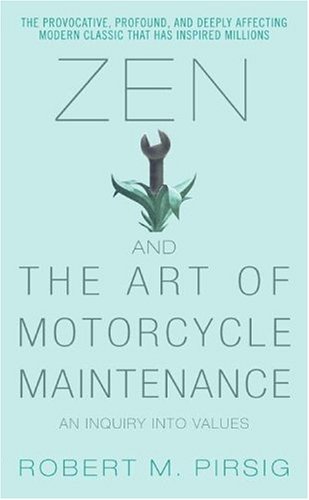
I need to apologize before I start writing this, because this "review" is going to suck ass. I read this book over a year ago and I should have posted about it back then, but I didn't. But now that I have read Atlas Shrugged and posted about it and its philosophy, I'm reminded of another book that was fairly enlightening, Zen and the Art of Motorcycle Maintenance. I'm reminded of this book now because it's also a philosophical treatise in the form of a novel. And just as with Atlas Shrugged, about two thirds of the way through this book, I decided that I was in the midst of a really interesting experience and I should try to hold on to some of the ideas. At the same time, the book I wrote about prior to Atlas Shrugged was On The Road, which is also about a road trip, several road trips actually, and was ultimately a poorly realized philosophical statement. Immediately after I wrote about On The Road I thought about writing abotu Zen and the Art of Motorcycle Maintenance, but I never did. But seeing as how ZAMM really kindof integrates my previous two book review endeavors, this is a good time to write it.
Anyhow, the book is ostensibly about a dude who's on a cross country motorcycle trip with his son. They begin the trip with some friends of the dad's and finish it alone. As far as plot goes, that's the whole story. Interspersed throughout the novel are some in depth analyses of how people view the world and the pros and cons of each. The narrator talks about his travelling companion who refuses to even think about the maintenance of his motorcycle and leaves it to a mechanic which eventually causes trouble for him. The narrator prefers to get to know his motorcycle and listen to its sounds and explore the various connections and such and so he can then make most of the minor repairs that are necessary along the way. This is a thinly veiled analogy to the world at large and what he calls a "romantic" view of life (don't think about maintenance) and a "classical" view of life (get to know your motorcycle). This stuff is pretty interesting and you get an idea of the basic framework of this guy's ideas.

Then about half way through the book he starts to flash back more and more to when he was a professor of rhetoric and he started on a quest for discovering the nature of what he calls "quality". At this point the people they were travelling with have either gotten to where they were going or have gone another way and it's just the son and the narrator. The book becomes much less about the journey and much more about these flashbacks and the idea of quality. There's a lot more stuff that comes out about this guy that you may or may not want to know if you plan on reading the book, so I'll leave it out. Anyway, at this point the guy kindof starts building the framework of a philosophy based on the idea of quality.

To say that this is a philosophy would be wrong. What this guy is doing is looking at all the existing philosophies from a new perspective and overlaying a framework into how to look at the world. I don't have too firm a grasp on it at this point to put into words since I read this so long ago. The main idea, though, is that he builds on this idea of quality while at the same time telling what I understand is an autobiographical story. Autobiographical in the sense that the guy actually did take a motorcycle trip with his son and he was a professor of rhetoric and everything else that happened actually did happen.

What's novel, then, are the machinations of this guy's thought process and his ideas about the way things are. In this respect, this book is eight million times more successful than On The Road. There's deep analysis of things that happen and the guy is interested in the whys and hows, what motivates people, how people react to him, and so forth. This stuff is really interesting.

Anyhow, while I was reading this book, the first couple hundred pages I kindof read through and it was holding my attention and then all of a sudden this book smacks you in the face and you can't put it down. It's broken into four sections and sections III and IV I read about twice as fast as sections I and II because it just got ridiculously interesting as he goes through the ideas of quality, looks at existing eastern and western philosophy, and tells the story of how he came to terms with his search for quality. Even if I had written this post in a timely fashion, I wouldn't really have words to describe the tone of the fourth part of the book other than fascinating.

I'll just end with this. After it was written this book was turned down by 121 publishers before finally being published. The woman who finally decided to publish it wrote a note to her boss (I'm paraphrasing, but I'm prtty close) that said, "I don't know how much it will sell, but this is quite probably a work of genius. I think we have to publish it." I agree with that.

Monday, June 22, 2009

The New York Times Where's Luke? Book Review: Atlas Shrugged

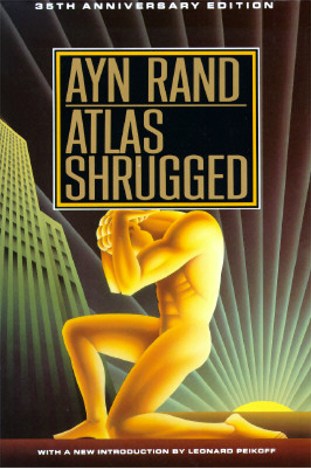
First of all, I apologize for not having posted much recently. I've been in the midst of a genuinely enlightening experience and, as such, I pushed off all non-essential activities in order to complete it. The enlightening experience in this case happens to be the reading of this book, Atlas Shrugged, by Ayn Rand. Now, you may be asking, if you know about Ayn Rand and her accompanying philosophy, "Since you have read 'Atlas Shrugged' and you say it was an enlightening experience, you have now become an objectivist, haven't you?" The answer is no. I would hope that one wouldn't make such a decision based on reading only one book. And a novel at that. But anyway, let me backtrack a minute in order for us all to be on the same page (pun war, anyone?).

I'm not going to tell you the story of this book, but the main premise is that all the people of ability in America go on strike. America is turning slowly into a socialist state and everything kinda sucks. That's basically the whole plot anyway, except it's clearly a lot more intricate in order to make up an 1100 page book. The plot of the book acts as a backdrop for Ayn Rand to espouse her philosophy, which is known as objectivism. As a whole, objectivism makes up an entire philisophy complete with ideas on the nature of existence, human nature, how people should conduct themselves and so on. As the book unfolds, the philosophy unfolds, until it finally reaches a climax in which the philosophy is spilled out in a metaphoric orgasm of rhetoric.

In reading this book, I was struck by two things. First, I have never read a book which has set out to accomplish something in particular and has accomplished it so clearly and without doubt. The basic premise, the philosophy, and the plot of the novel all mesh in together seamlessly. The introduction of her ideas and the logical arguments leading up to them just fall like dominoes as she makes each progressive point. It's astounding to see the whole thing come together and to see the direct line of logic that flows from page 1 to page 1100.

The second thing that struck me was how closely Ayn Rand's philosophy matched with my own personal philosophy. I don't believe I've ever really heard anything I would consider to be a personal philosophy put into words, and it really consolidated my ideas about the way things are. I wouldn't say there is a one to one correlation between the two, and I'm not particularly interested in the entire philosophy at this point, but I'm intrigued to read more about it.

In summary, this book is amazing. If you have a couple of free months. I would suggest you read it.

PS - After this period of inactivity, it's clear that my personal guarantee is not in any danger of being violated.

Thursday, March 26, 2009

Book Review: The Places In Between (Rory Stewart: Harcourt, 2006)

The title of this post is a misnomer, because I have no intention of "reviewing" this book in any meaningful way. If you want to read a review, check out this one. It is very good, and so is the book.

No, the purpose of this post is to share my two favorite lines from the book, which I just finished today. The author - who walked across Afghanistan, alone, in 2002 just after the American-led invasion - gives an incredibly raw and unadorned portrayal of that "fascinating, unfortunate country." These two lines capture it perfectly:
"Qasim left the room without speaking. I smiled at the man with the red lips but he just continued to stare. I took out my notebook and sketched Abdul Haq, who was sleeping on his back with his rifle across his thighs, his large chest slowly rising and falling. He had a clear, honest face. I found my fondness for him difficult to reconcile with what I knew of his enthusiasm for killing people and making small children cry," p. 79.
and
"The next day I went to watch the Buzkashi game taking place on a series of fields - some fallow, some plowed and planted - just to the east of the empty Buddha niches. Buzkashi a form of polo played with a dead goat instead of a ball," p. 262
Damn. Road trip, anyone?

Monday, March 16, 2009

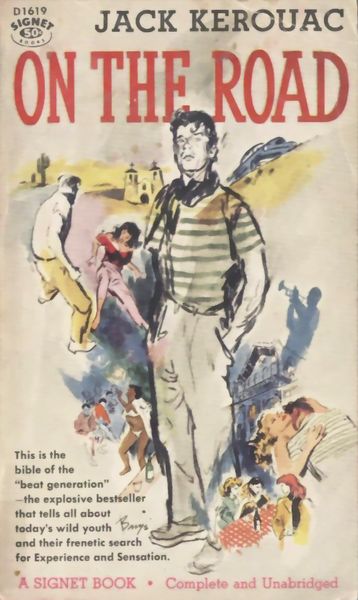
Things That Are Overrated: On The Road

I struggled for a moment trying to decide wether to put this in the overrated category, or just to make an arbitrary post about the book, but since my general conclusion was that the book is fairly overrated, I decided to use the pre-existing theme of the blog. I read this book last week, which also speaks to the lack of posting for those few days, for several reasons. Obviously it's highly regarded, so I figured it would be good. Also I'm into the classics, and this seemed like one of them. It's also just a good pop culture reference and I take my pop culture responsibilities seriously.

I'm not really certain where to begin. This book is one of the more influential works of the 20th century. There are plenty of songs and books, poems and movies that owe their existence to On The Road, but I can't really say that I connected to it. I think when the book was released it was met with praise about there being an underlying truth to it that transcends the time it was written in, but I don't think that's the case. I think the book immediately influenced people in the time it was written, but today it's pretty dated. Additionally, I'm not really in love with the prose that seems to be the defining trait of this novel.

A (very) short summary. This guy Sal is trying to make it as a writer and his not being tied down to a job or anything allows him to go all over the country to visit acquaintances who are spread all over. He hithchikes, takes buses, drives, and eventually works his way all over the country. At the same time this other dude, Dean, accompanies him a lot of the time. They rarely have a specific agenda other than to go around, listen to jazz, and pick up girls. There's a bit more to it, but that's the gist.

The summary is necessary in pointing out that the book is essentially autobiographical. Jack Kerouac sat down to write the book with the idea that he was telling his wife about his life in the years before he met her. The original manuscript had the real names of the people he encountered and everything, and were later changed during editing. I mention this because this wasn't a story that was created. There's no particular genius in just telling about things you did. With that being said, presenting that material in a way that's insightful or that leads to larger conclusions about life would certainly be a worthwile venture. But this isn't that. There is no analysis, there is no grand conclusion, it's all just exposition. This type of work could lead one to really analyze each scenario and decide what lessons one might have learned, especially given that the plot has essentially written itself.

As a result, the whole thing is really just kindof empty. The only time the prose really sings is in three separate sections when he's describing himself watching live jazz performances. Those sections are loaded with purple prose and captivating metaphors and are easily the highlight of the book. Outside of that, he might as well just be telling you about last night's episode of American Idol.

Now I think maybe the point of the book is that the whole thing is kindof empty. The book, life, and everything else. It is the defining work of the "beat" generation, so named because, in one respect, they are beaten down by life, and have, in one way or another, lost their way. But I didn't get the beaten down by life thing from the book. What I got instead was that this was a book about a bunch of losers who shirked thier responsibilities and allowed themselves to be easily swayed by thier ids, and drugs, and one guy who they all knew was a loser, but who was fun to be around until he no longer needed them at which point he would leave without a second thought.

There's an underlying sadness in this book. The main character, Sal, apparently a thinly veiled version of Kerouac himself, has no goals, no ideals, no plans, and no ideas of his own. And this is a book about a lost soul, in the same way that The Catcher In The Rye is about a lost soul, but it's completely different. These two books remind me of each other in the aforementioned lost soul wandering around looking for meaning type of way, but at the same time, On The Road is a far inferior version. What is great about The Catcher In The Rye is that there is a definite universality in the Holden character. We are not exactly the same as him, but we can identify with him and his journey. The style that Catcher is written in is similar to this one, though it is interspersed with Holden's interesting philosophy on life. And even though he's a lost soul, and even though he may never find his way, we at least know that he's striving toward something. The Sal character in on the road doesn't offer any of that. The one thing I know he's passionate about is jazz. Other than that, I can't say anything more about him other than the fact that he took these various road trips.

This is really where the book falls short for me. There is no underlying anything, other than sadness. I wish there was more beneath the surface and there really just isn't here. It's just a retelling of events. If we gave MMG 6 beers, he could recount an On The Road type of story about a fraternity party or a ski trip.

In conclusion, this book is overrated. It feels dated to me and the references feel stale. The Catcher In The Rye is just as old, but doesn't feel dated, and offers more than just a surface story. What's missing in On The Road, then, is that universal element, that timeless piece, the marrow.